
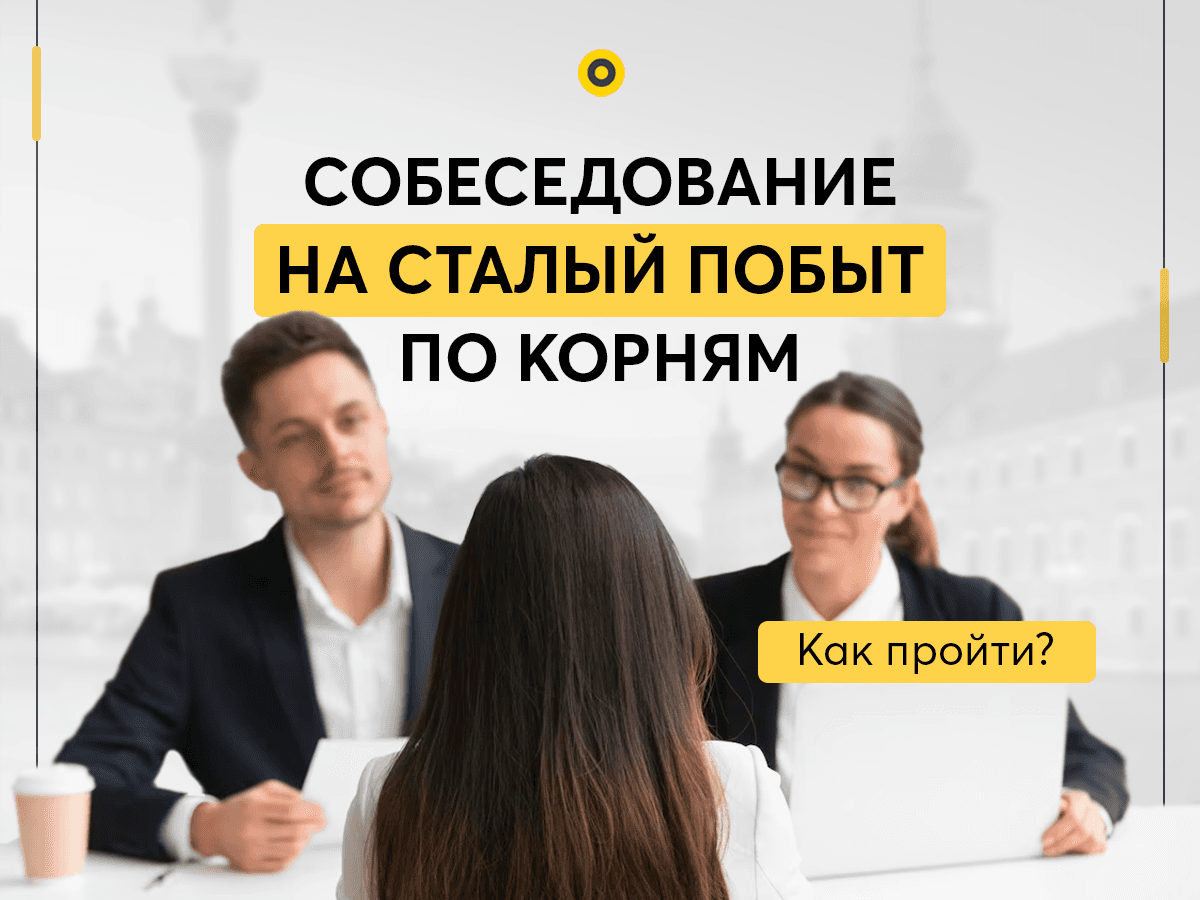
When applying for pobyt stały based on Polish roots, passing the interview successfully is a crucial step.
The main objective tested during the interview is whether you truly feel Polish, specifically: how this nationality was instilled in you since childhood, how well you know the Polish language, and how familiar you are with Polish history and traditions.
01What mistakes are made during the interview?
Many people make the same mistake—they memorize some cliché traditions and simply prepare for the interview using a textbook. Remember, this conversation is not an exam. The Inspector may ask various trick questions, so we recommend starting by talking through your story and creating a so-called "legend" around which your interview will revolve. You need to think through, construct, or solidify the understanding of Polish nationality specifically within your family, which was instilled in you from early childhood.
Here is an example situation: "After Poland separated from the Soviet Union, your relatives wanted to visit their historical lands. If you grew up in the post-Soviet era, it was very important for your relatives to instill Polish nationality in you; whereas if you grew up while the Soviet Union still existed, your heritage might have been kept secret from you when you were little so you wouldn't let it slip anywhere, and then at an older, conscious age, your grandfather loved to be nostalgic and tell you about Polish culture and traditions."
You must stick to your story throughout the entire interview and be ready to answer any question.
What questions are most frequently asked at the interview?
Inspectors love asking open-ended questions, so you will subsequently be asked about Polish history. At this point, you must remember that everything still revolves around your personal story. You are not required to immediately start listing every historical date you know, because the Inspector will instantly notice that you simply memorized them. Each of us has grandparents who loved talking about certain historical events. For example, your grandfather loved talking about how Poland separated from the Soviet Union, he knows everything about it and often talked about it. Therefore, when you are asked an open-ended question, you tie it back to your story. You can also add that you are personally interested in history, study it, and if there are any specific questions, you are ready to answer them.
You will also be asked about traditions:
"What traditions did your family follow?"
For example, you can talk about how Wigilia was celebrated in your family, but don't overdo it: i.e., you don't need to tell the history of the holiday itself, it will be enough to focus strictly on your family. "While everyone else celebrated Christmas on the seventh, we celebrated it on the 25th. Grandmother cooked fish, we all gathered together at the table, etc."
Testing your knowledge of the Polish language
The next thing they will check is your knowledge of the Polish language. Remember, you are not coming to an exam where your grammar will be tested. You are simply showing that you plan to settle down here and are trying to learn Polish to achieve this. We recommend staying calm and simply having a natural conversation.
Also, avoid common mistakes! Speaking Ukrainian while adding Polish endings to words (thereby distorting the language) is not a good idea. The inspector will notice this immediately and may draw the wrong conclusions.
Use polite and proper expressions in your speech: "Proszę Pana", "słucham", "niestety", etc.
You also have the option to attend the interview with an interpreter, but we do not recommend doing this, as it will show your reluctance to learn Polish and cast doubt on how much you truly consider yourself a Pole.
02Lifehack from Spravochnik Immigranta
And the final lifehack we can offer for passing the interview: provide the inspector with materials confirming that you cultivate Polish traditions. These could be photos from the Christmas table, as well as from memorable historical sites.
Based on this entire article, our main advice for you is to approach the interview in a way that is based on your personal story, rather than on materials you have memorized. You can find more interesting information on our blog.
Useful materials:
Karta pobytu under UKR Status – required documents and processing times in 2023
Karta pobytu with UKR status – how to get it in 2023?
UKR Status or Residence Permit in Poland?
Starting cooperation with us – consultation and first meeting.
Legalization of work for IT specialists in Poland.
Polish citizenship through marriage. Nuances you need to know!
How to change jobs if you have already received your Karta pobytu?
Documents without queues ONLINE in Poland – IS IT POSSIBLE? Set up a Profil Zaufany
Top 3 mistakes of beginner entrepreneurs in Poland.
Residence Permit and Business in Poland. How to run a business to get a Karta pobytu?
International drivers – legal stay and work in the EU.
Police clearance certificate in Poland. How to get it?
What to do if your Karta pobytu application is rejected in Poland?